

Ford Bronco vs Bronco Sport: What’s the Difference and Which One Should You Buy?
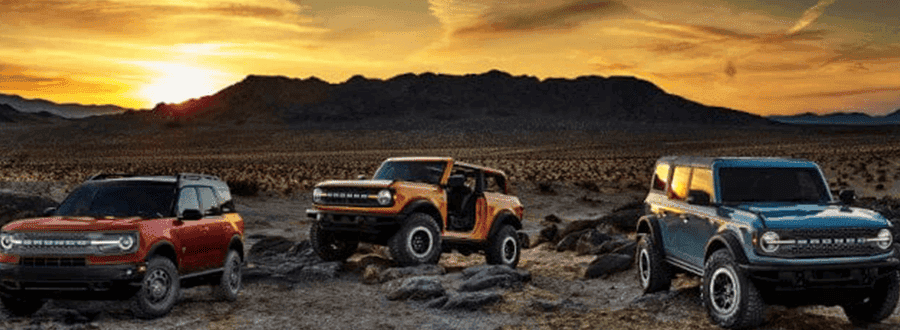
Buy the full-size Ford Bronco if you require maximum rock-crawling capability, removable doors, a body-on-frame platform, and up to 3,500 pounds of towing capacity. Choose the compact Ford Bronco Sport if your priority is daily suburban driving, easy parking maneuverability, standard all-wheel drive, higher fuel efficiency, and up to 2,700 pounds of towing wrapped in a versatile unibody package.
Both models carry forward the iconic design language of the Ford off-road family, but they are engineered for fundamentally different driving demands. The full-size Ford Bronco is built on a heavy-duty truck chassis designed to conquer severe trails, deep water crossings, and technical off-road obstacles. Available in both two-door and four-door body styles with a removable hardtop or soft top, it delivers an open-air driving experience that few modern SUVs can replicate.
Conversely, the Ford Bronco Sport uses a refined crossover platform that excels as a daily driver. It provides smooth highway manners, responsive steering, and impressive interior passenger headroom while maintaining genuine light-duty trail capability. While complete specifications for future model years remain pending official release, drivers seeking an adventurous vehicle can explore current models today by taking a quick drive to our Stuart showroom location or reaching out directly to (772) 287-0955 to speak with our sales staff.
What Is the Price Difference Between the Ford Bronco and Bronco Sport?
The Ford Bronco Sport carries a lower starting price, with the entry-level Big Bend trim beginning at an MSRP of $31,695 and top-tier trims like the Badlands scaling to around $40,115. The larger Ford Bronco starts at an MSRP of $40,795 for entry configurations and quickly rises past $50,000 when optioned with heavy-duty off-road packages or upper trim levels.
This price gap reflects the underlying mechanical engineering of each vehicle. The Bronco Sport delivers exceptional value for buyers who want rugged styling, standard all-wheel drive, and modern cabin technology without paying for extreme rock-crawling hardware they may never use. Trims such as the Big Bend, Heritage, Free Wheeling, Outer Banks, and Badlands give shoppers flexibility across a wide range of price points.
For drivers seeking maximum trail equipment without breaking the bank, adding the Sasquatch Package to a Bronco Sport Badlands brings the total cost to around $46,500. A similarly equipped full-size Bronco with its own Sasquatch Package typically costs more depending on configuration. Shoppers comparing overall value across different price ranges can also browse our quality pre-owned SUV inventory to evaluate how both models hold their resale value over time.
How Do the Mechanical and Towing Capabilities of the Bronco and Bronco Sport Differ?
The full-size Ford Bronco utilizes a truck-based body-on-frame chassis with standard 4×4 and offers up to 3,500 pounds of towing (and up to 4,500 pounds when properly configured on select high-output trims), whereas the unibody Ford Bronco Sport maxes out at 2,200 pounds of towing with its standard engine and 2,700 pounds when equipped with the larger turbo engine and tow package.
Under the hood, the powertrain lineups serve distinct driving priorities:
- Ford Bronco Powertrains:
- Standard 2.3-liter EcoBoost four-cylinder engine generating roughly 275 to 300 horsepower.
- Available 2.7-liter V6 EcoBoost engine delivering 330 horsepower and 415 lb-ft of torque.
- High-performance 3.0-liter V6 EcoBoost exclusive to the Raptor trim, producing up to 418 horsepower.
- Transmission options include a 7-speed manual with a crawler gear or a smooth-shifting 10-speed automatic.
- Ford Bronco Sport Powertrains:
- Standard 1.5-liter EcoBoost three-cylinder engine delivering 181 horsepower and 190 lb-ft of torque.
- Available 2.0-liter EcoBoost four-cylinder engine (standard on Badlands) outputting 250 horsepower and 277 lb-ft of torque.
- Both engines pair exclusively with a calibrated 8-speed automatic transmission and standard all-wheel drive.
The mechanical distinctions extend to suspension and drivetrain architecture. The full-size Bronco employs an available HOSS Suspension system, a two-speed transfer case with true low-range gearing, and available front and rear electronic locking differentials. The Bronco Sport uses a fully independent suspension setup that delivers a smoother, quieter ride on paved roads.
For local weekend adventures—such as launching a small jet ski or hauling trail gear around Stuart—the Bronco Sport handles light trailers effortlessly. For heavier boats, camper trailers, or serious mud-crawling, the full-size Bronco remains the necessary choice. Buyers looking for capability with full factory backing can also explore our certified pre-owned Ford lineup to inspect late-model trade-ins.
Which Ford SUV Should You Buy for Extreme Off-Road Capability?
You should buy the full-size Ford Bronco if your off-road ambitions involve steep rock obstacles, deep ruts, or high-speed desert running, as it offers superior ground clearance, removable doors, disconnecting front sway bars, and massive 35-inch tires.
The full-size Bronco comes standard with G.O.A.T. Modes (Goes Over Any Type of Terrain), Trail Control, and Trail Turn Assist, which tightens the vehicle’s turning radius on narrow trails by braking the inside rear wheel. When optioned with the Sasquatch Package, it gains Bilstein position-sensitive dampers, front and rear locking differentials, and high-clearance fender flares.
However, the Ford Bronco Sport is far more capable off-road than typical compact crossovers. In Badlands trim, it features a specialized twin-clutch rear-drive unit that can send torque to either rear wheel, underbody steel bash plates, and an aggressive Rally mode tuned for high-speed sand trails. During high-speed sand runs, the lighter unibody frame of the Bronco Sport gives it nimble turn-in response and sharp handling.
When comparing both models on our sales floor, buyers usually ask to see how the rear glass flips open on the Bronco Sport before testing the removable roof latching on the big Bronco. For coastal drives out toward Jensen Beach, the Bronco Sport provides plenty of ground clearance for sandy parking lots and light trails while maintaining superior fuel efficiency at an EPA-estimated 27 mpg combined with the base engine or 23 mpg combined on the Badlands model.
To explore options for upgrading your vehicle, you can check our new Ford Bronco Sport models online and estimate your trade-in value before visiting our dealership.
Why Test Drive and Finance Your Ford SUV at Essential Ford of Stuart?
Essential Ford of Stuart provides a streamlined, transparent buying experience that lets you compare the Bronco and Bronco Sport side by side on a real-world test drive loop.
Choosing between a body-on-frame 4×4 and a versatile unibody crossover comes down to how a vehicle feels in daily traffic, how easy it is to park, and how comfortable the cabin remains at highway speeds. Our knowledgeable sales staff will walk you through every feature, from adjusting driver-assist technologies to configuring rear cargo organizers and split-folding seats.
Our finance center works directly with Ford Credit and multiple lending institutions to secure competitive rates and flexible terms for your vehicle purchase. You can jumpstart the process from home by filling out our online auto financing application to get pre-approved before setting foot in the showroom.
Common Questions Buyers Ask About the Bronco and Bronco Sport
Q: Does the Ford Bronco Sport have removable doors and a removable roof?
No, the Ford Bronco Sport is built on a unibody crossover platform with permanent steel doors and a fixed roof structure. It features an available power moonroof and a flip-up rear glass hatch for easy cargo access. If you want open-air driving with removable doors and a removable roof, you must select the full-size Ford Bronco.
Q: What are the main fuel economy differences between the two models?
The Ford Bronco Sport with the standard 1.5-liter EcoBoost engine earns an EPA-estimated 27 mpg combined ( 25 mpg city / 29 mpg highway). The higher-output 2.0-liter EcoBoost on the Badlands trim gets an EPA-estimated 23 mpg combined. The larger, heavier Ford Bronco averages around 20 mpg combined depending on engine size, transmission, and whether you equip 35-inch off-road tires.
Q: What features are included in the Sasquatch Package on the Bronco Sport?
On the Ford Bronco Sport, the Sasquatch Package includes a 0.6-inch suspension lift, Bilstein rear shocks, 29-inch all-terrain tires, a twin-clutch rear differential, high-clearance fender flares, steel underbody skid plates, and additional off-road drive modes. It provides upgraded trail protection without sacrificing daily road comfort.
Q: How much can each SUV tow when properly equipped?
The Ford Bronco Sport can tow up to 2,200 pounds with the 1.5-liter EcoBoost engine and up to 2,700 pounds with the 2.0-liter EcoBoost engine and tow package. The full-size Ford Bronco can tow up to 3,500 pounds on standard trims, while the high-performance Raptor trim reaches a maximum tow rating of 4,500 pounds.
Q: What factory warranty coverage comes with these Ford SUVs?
Both models come with Ford factory warranty protection, which includes a 3-year/36,000-mile basic warranty and a 5-year/60,000-mile powertrain warranty. Owners also receive 5 years or 60,000 miles of manufacturer Roadside Assistance covering emergency towing, jump-starts, and flat tire changes. To learn more about our dealership team and warranty options, contact our sales department.
Prices and MSRP referenced in this article are estimates for informational purposes only and do not constitute an offer to sell. See dealer for complete details.
Fuel economy estimates shown may differ from official EPA ratings and should not be relied upon as a guarantee of actual vehicle performance.

0 comment(s) so far on Ford Bronco vs Bronco Sport: What’s the Difference and Which One Should You Buy?