

2026 Ford Maverick Hybrid vs EcoBoost: Which Powertrain Is Better for Florida Drivers?
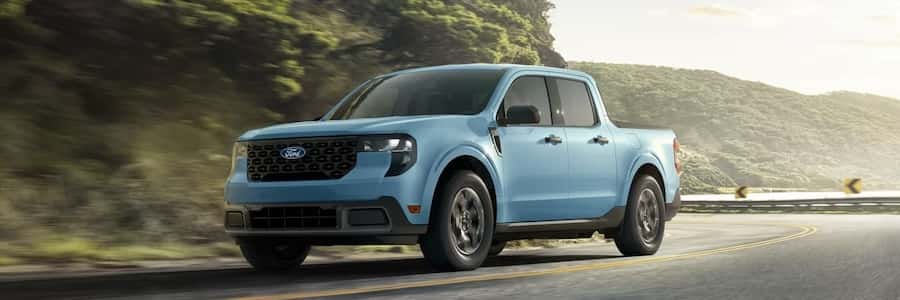
The 2026 Ford Maverick 2.5L Hybrid is best for daily Florida commuters prioritizing maximum fuel economy in heavy traffic, while the turbocharged 2.0L EcoBoost is superior for drivers needing maximum towing capacity, fast highway passing power, and all-weather capability. Choosing between them depends on whether your daily driving involves stop-and-go traffic or hauling heavy loads across state highways.
For drivers along the St. Lucie River in Stuart who load up fishing gear or tow light recreational equipment, both powertrains deliver distinct advantages. The standard hybrid setup utilizes a 2.5-liter four-cylinder engine paired with an electric motor to generate 191 hp, routing power through an electronically controlled continuously variable transmission ( CVT). This combination focuses on efficiency, smooth power delivery, and low cost of operation during city driving.
On the other hand, the available 2.0-liter turbocharged EcoBoost engine produces 250 hp and 277 lb-ft of torque, shifting through a responsive 8-speed automatic transmission. For buyers who prioritize quick throttle response, heavier hauling capacity, or off-road capability, the EcoBoost provides traditional truck muscle in a compact footprint.
At Essential Ford of Stuart, our team can guide you through both powertrain options on a test drive so you can evaluate the performance, cab comfort, and cargo versatility firsthand. You can explore options at our showroom on Federal Highway in Stuart or give our team a quick call to verify incoming inventory.
How Do the Hybrid and EcoBoost Compare on Horsepower, Torque, and Acceleration?
The 2.0L EcoBoost engine delivers significantly higher output at 250 hp and 277 lb-ft of torque compared to the 2.5L Hybrid system’s 191 hp and 173 lb-ft of torque, producing faster 0-60 mph acceleration times.
Under the hood, the two engines represent completely different engineering philosophies. The 2.5L Hybrid uses an Atkinson-cycle inline four-cylinder engine supported by an electric traction motor. This setup provides smooth off-the-line torque assistance from the battery, but top-end pull is engineered for efficiency rather than speed. Power reaches the wheels through a seamless CVT, which keeps engine speeds steady during acceleration. On front-wheel-drive and all-wheel-drive configurations across the XL, XLT, and Lariat trims, the hybrid delivers consistent, refined power.
The turbocharged 2.0L EcoBoost engine focuses on immediate power delivery. With 277 lb-ft of torque peaking low in the RPM range, the EcoBoost pulls strongly from a stop and continues accelerating hard through its gears. The engine relies on an 8-speed automatic transmission on most trims, while the street-styled Lobo trim features a tuned 7-speed automatic with paddle shifters for sharper gear control.
In acceleration tests, the 2.0L EcoBoost propels the Maverick from 0 to 60 mph in roughly 5.8 to 6.3 seconds depending on the trim and drivetrain. The 2.5L Hybrid completes the same sprint in approximately 6.7 to 7.7 seconds. While the hybrid feels lively around town thanks to instant electric motor engagement, the EcoBoost is unassisted turbo power that pulls harder when full acceleration is demanded.
To compare specs and trims in detail, explore our new Ford Maverick inventory to see which engine option fits your daily driving needs.
Engine & Performance
Powertrain specs by trim
| Feature | Lariat AWD | Lobo Premium 4WD | Lobo Standard 4WD | Tremor 4WD | XL AWD | XL FWD | XLT AWD | XLT FWD |
|---|---|---|---|---|---|---|---|---|
| Engine | 2.5L | 2L | 2L | 2L | 2.5L | 2.5L | 2.5L | 2.5L |
| Horsepower | 191 hp | 250 hp | 250 hp | 250 hp | 191 hp | 191 hp | 191 hp | 191 hp |
| Torque | 173 lb-ft | 277 lb-ft | 277 lb-ft | 277 lb-ft | 173 lb-ft | 173 lb-ft | 173 lb-ft | 173 lb-ft |
| Transmission | CVT | automatic 7-speed | automatic 7-speed | automatic 8-speed | CVT | CVT | CVT | CVT |
| Drivetrain | All-wheel drive | All-wheel drive | All-wheel drive | All-wheel drive | All-wheel drive | Front-wheel drive | All-wheel drive | Front-wheel drive |
Is the EcoBoost Better for Highway Passing and Heavy Traffic on Florida Highways?
Yes, the 2.0L EcoBoost is noticeably better for highway passing on high-speed Florida corridors due to its 277 lb-ft of torque and quick-shifting 8-speed automatic transmission, whereas the 2.5L Hybrid excels in urban stop-and-go gridlock.
High-speed highway travel presents specific demands for compact trucks. Merging onto fast-moving interstate lanes requires rapid speed pickup between 50 mph and 70 mph. The EcoBoost engine’s turbocharger spool provides immediate mid-range passing torque. When you step on the accelerator, the 8-speed automatic downshifts quickly to place the engine right in the heart of its powerband, allowing the truck to execute swift highway passing maneuvers even when loaded with cargo or passengers.
For long highway commutes along I-95 near Port St. Lucie, the EcoBoost provides extra passing reserve when merging into fast traffic flows. Conversely, in heavy traffic congestion where vehicles crawl at lower speeds, the 2.5L Hybrid powertrain shines. In stop-and-go situations, the hybrid operates frequently in electric-only EV mode, shutting down the gas engine when coasting or stopped to save fuel and maintain a quiet cabin environment.
While the hybrid delivers ample power for standard highway cruising, its CVT requires high engine revs under hard passing efforts, resulting in a continuous engine note rather than the decisive gear changes of the EcoBoost. If your routine involves frequent long-distance highway travel at elevated speeds, the EcoBoost offers more relaxed passing confidence.
If you are considering a pre-owned truck or comparing model years, you can also browse our selection of used vehicles to see all available powertrain options.
How Does Florida Heat and Air Conditioning Usage Impact Maverick Hybrid MPG?
Continuous air conditioning usage in intense Florida heat slightly reduces the 2.5L Hybrid system’s city fuel economy by roughly 2 to 4 mpg because the gas engine must restart periodically to keep the electric climate compressor and battery charged.
Florida’s climate presents sustained high ambient temperatures for many months of the year. Unlike traditional gas vehicles that run their climate control compressor off an engine belt, the 2.5L Hybrid Maverick uses an electric air conditioning compressor powered directly by the high-voltage hybrid battery. This engineering design allows the cabin to remain ice-cold at red lights even when the internal combustion engine cycles off.
However, when ambient temperatures climb past 90 degrees, the high demand for climate control and thermal battery management requires energy from the hybrid battery pack. Once the battery charge drops below a set threshold, the 2.5-liter gas engine turns on automatically to drive the generator and recharge the pack. In summer city driving, this extra engine runtime reduces real-world fuel economy from peak estimates, though efficiency remains remarkably high overall.
When buyers walk around the lot during mid-summer test drives, they frequently ask whether running the cold AC continuously drains the hybrid battery; we show them how the electric compressor operates seamlessly without sacrificing cabin comfort.
Even with continuous air conditioning load, the hybrid powertrain achieves impressive efficiency. Official EPA ratings for the hybrid reach up to 39 city / 32 hwy with all-wheel drive, and up to 42 mpg city / 35 mpg highway on front-wheel drive models. By comparison, the non-hybrid EcoBoost returns approximately 22 to 23 mpg in city driving and 30 mpg on the highway.
Shoppers interested in efficient pre-owned options can also evaluate our certified pre-owned Ford lineup to check available hybrid and EcoBoost models.
Fuel Economy
Fuel economy and range by trim
| Feature | Lariat AWD | Lobo Premium 4WD | Lobo Standard 4WD | Tremor 4WD | XL AWD | XL FWD | XLT AWD | XLT FWD |
|---|---|---|---|---|---|---|---|---|
| MPG | 39 city / 32 hwy / 36 combined | 21 city / 30 hwy / 24 combined | 22 city / 32 hwy / 25 combined | 21 city / 27 hwy / 23 combined | 40 city / 34 hwy / 37 combined | 42 city / 35 hwy / 38 combined | 40 city / 34 hwy / 37 combined | 42 city / 35 hwy / 38 combined |
Which Maverick Powertrain Handles Heavy Florida Rain, Flat Terrain, and Towing Best?
The 2.0L EcoBoost paired with All-Wheel Drive is the superior choice for heavy tropical rainstorms and towing up to 4,000 lbs, while the 2.5L Hybrid is ideal for cruising flat Florida terrain efficiently.
Florida’s geography consists mostly of flat coastal terrain, but heavy tropical downpours and wet road conditions require proper traction management. Both the hybrid and EcoBoost engines offer available Intelligent All-Wheel Drive. On wet pavement, Ford’s AWD system constantly monitors wheel speed and throttle position, sending power to the rear wheels before slippage occurs to maintain stability during sudden cloudbursts.
When it comes to towing capability, the EcoBoost holds a distinct advantage. While both the hybrid and EcoBoost carry a standard towing rating of 2,000 lbs, only the 2.0L EcoBoost can be optioned with the 4K Tow Package. This package equips the Maverick with a Class III trailer hitch, a trailer brake controller, seven-pin wiring connectors, and upgraded cooling fan systems for the engine and transmission. The increased 4,000 lbs towing capacity easily accommodates small boat trailers, dual-axle utility trailers, or pop-up campers.
Payload across the lineup reaches 1,500 lbs inside the 4.5-foot truck bed. The bed features Ford’s FLEXBED system, which incorporates pre-molded slots for 2×4 lumber dividers, multi-position tie-down cleats, and pre-wired 12-volt electrical leads for mounting bed accessories or lighting.
To see how a trade-in can help lower your payments on a new truck, you can value your trade-in online before stopping by our dealership.
Find Your 2026 Ford Maverick Hybrid or EcoBoost at Essential Ford
Essential Ford in Florida offers both the 2.5L Hybrid and 2.0L EcoBoost Mavericks, letting you test drive and decide which powertrain suits your driving needs best.
Across the lineup, the 2026 Ford Maverick is available in distinct trim levels to suit every driver’s style and budget. Pricing begins with the XL FWD at a Base MSRP of $28,145, while the XL AWD starts at $30,365. Stepping up to the versatile XLT FWD brings a Base MSRP of $30,645, and the XLT AWD is priced at $32,865.
For luxury-focused buyers, the Lariat AWD features a Base MSRP of $38,090. Performance enthusiasts can choose the Lobo Standard 4WD at $35,930 or the Lobo Premium 4WD at $41,425. Off-road adventurers can opt for the Tremor 4WD at a Base MSRP of $40,645. All models carry a standard factory destination charge of $1,845.
Our team at Essential Ford of Stuart is ready to help you navigate trim options, test drive both engine options back-to-back, and find competitive finance plans. Plan a visit to visit us in Stuart today or call our sales desk at (772) 287-0955 to schedule your Maverick test drive.
Common Questions About the 2026 Ford Maverick Hybrid vs. EcoBoost
Q: What is the primary difference in towing capacity between the Maverick Hybrid and EcoBoost?
The standard towing capacity for both the 2.5L Hybrid and 2.0L EcoBoost is 2,000 lbs. However, adding the optional 4K Tow Package is exclusive to EcoBoost models, increasing maximum towing capacity to 4,000 lbs for heavier loads such as boats or travel trailers.
Q: Does the 2026 Ford Maverick Hybrid offer All-Wheel Drive?
Yes, the 2.5L Hybrid is available with All-Wheel Drive on XL, XLT, and Lariat trims, pairing high fuel efficiency with enhanced traction on wet pavement and loose surfaces.
Q: Which 2026 Maverick trims are offered exclusively with the EcoBoost engine?
The performance-tuned Lobo street truck trim and off-road-focused Tremor trim come exclusively with the 2.0L EcoBoost engine and specialized All-Wheel Drive setups.
Q: What factory warranty covers the 2026 Ford Maverick hybrid components?
The 2026 Ford Maverick comes with a 3-year/36,000-mile bumper-to-bumper warranty, a 5-year/60,000-mile powertrain warranty, and specialized hybrid components are covered for 8-year/100,000-mile protection.
Q: Is the EcoBoost or Hybrid cheaper to purchase initially?
The base XL FWD with the 2.0L EcoBoost starts at an MSRP of $28,145, while adding the 2.5L Hybrid on certain front-wheel-drive configurations carries a modest price delta of about $1,000, making both powertrains exceptionally competitive in initial purchase value.
To read more about our team and customer commitment, you can learn more about our dealership or apply for Ford financing online to start your purchase process.

0 comment(s) so far on 2026 Ford Maverick Hybrid vs EcoBoost: Which Powertrain Is Better for Florida Drivers?