

2026 Ford Explorer vs 2026 Honda Pilot: Which 3-Row SUV Is Better for Treasure Coast Families?
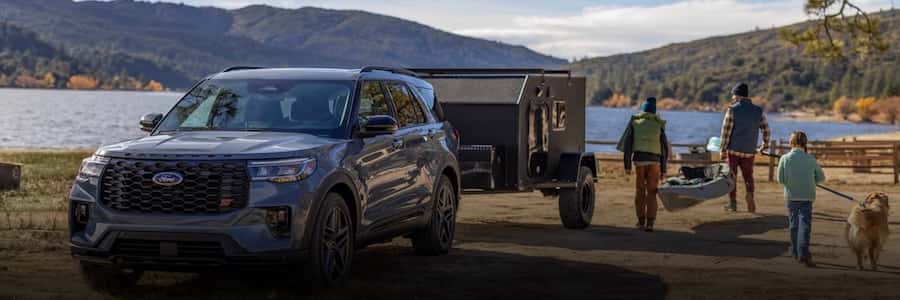
The 2026 Ford Explorer outperforms the 2026 Honda Pilot for local families by delivering superior turbocharged power, a lower entry price starting at $38,465, advanced tech including available BlueCruise hands-free driving, and a standard 5,000-pound towing capacity across all trims. While the Honda Pilot offers slightly more total passenger volume, the Explorer provides stronger acceleration, higher highway fuel economy, and a more engaging rear-wheel-drive platform built for Florida highways.
Selecting the ideal three-row SUV comes down to how your family balances daily utility, performance, and long-term financial value. The Explorer is engineered on a rear-wheel-drive architecture with available intelligent four-wheel drive, giving it an athletic posture and composed handling whether you are driving along the coast in Stuart or heading out on I-95. Power comes standard from a 2.3L EcoBoost® turbocharged four-cylinder engine producing 300 horsepower and 310 lb-ft of torque, mated to a responsive 10-speed automatic transmission.
By contrast, the Honda Pilot relies on a naturally aspirated 3.5-liter V6 making 285 horsepower and 262 lb-ft of torque. The Pilot’s front-wheel-drive base platform offers capable family transport, but its acceleration feels noticeably more sluggish during highway merging and passing maneuvers. Additionally, the Explorer offers an available 3.0L EcoBoost® V6 on higher trims that pumps out an incredible 400 horsepower and 415 lb-ft of torque—a level of performance the Pilot lineup simply cannot match.
Our team at Essential Ford of Stuart is ready to walk you through every feature and configuration. You can drop by our showroom location on Federal Highway or give us a quick call at (772) 287-0955 to schedule your test drive today.
Which SUV Is Cheaper to Start and Holds Its Resale Value Better: Explorer or Pilot?
The 2026 Ford Explorer starts at a lower base MSRP of $38,465 compared to the 2026 Honda Pilot’s starting price of $42,395, giving budget-conscious buyers an immediate price advantage of nearly $4,000 while maintaining competitive long-term resale value.
Starting price is one of the most critical factors for family vehicle buyers. The entry-level Active 100A RWD model carries a base MSRP of $38,465 (plus a $1,795 destination charge), making three-row capability exceptionally accessible. Moving up the trim ladder allows families to select the exact level of luxury and performance they require:
- Active (RWD starting at $40,585; 4WD at $42,585)
- ST-Line (RWD starting at $45,155; 4WD at $47,155)
- Tremor (Standard 4WD at $48,965)
- Platinum (RWD starting at $50,965; 4WD at $52,965)
- ST (RWD starting at $54,905; 4WD at $56,905)
The Honda Pilot starts significantly higher, with its base Sport trim opening at $42,395, and top-tier models like the Black Edition reaching $55,195. Because the Explorer starts lower, buyers can upgrade to higher-equipped trims—like the sport-styled ST-Line—for roughly the same price as an entry-level or mid-tier Pilot.
In terms of resale value, both vehicles hold high residual demand in the pre-owned market. However, the Explorer benefits from its highly desirable EcoBoost powertrain lineup, strong towing demand, and ubiquitous driver-assist technology. High demand for used three-row domestic SUVs ensures that a well-maintained Explorer retains strong trade-in leverage when you are ready to upgrade. You can easily value your trade-in online before visiting us, or explore our current new Ford Explorer inventory to see available pricing and package options.
Pricing
Pricing by trim
| Feature | Active 4WD | Active 4WD 100A | Active RWD | Active RWD 100A | Platinum | Platinum 4WD | ST | ST 4WD | ST-LINE 4WD | ST-LINE RWD | Tremor 4WD | Utility Police Interceptor 4×4 |
|---|---|---|---|---|---|---|---|---|---|---|---|---|
| Base MSRP | $42,585 | $40,465 | $40,585 | $38,465 | $50,965 | $52,965 | $54,905 | $56,905 | $47,155 | $45,155 | $48,965 | $48,550 |
| Destination charge | $1,795 | $1,795 | $1,795 | $1,795 | $1,795 | $1,795 | $1,795 | $1,795 | $1,795 | $1,795 | $1,795 | $1,695 |
Towing Power, MPG, and Highway Comfort: Which SUV Handles Florida Road Trips Best?
The 2026 Ford Explorer delivers better overall trip capability than the Honda Pilot thanks to its standard 5,000-pound maximum towing rating, higher highway fuel economy reaching up to 20 city / 29 hwy MPG, and a smoother, quieter ride on long highway stretches.
For families towing a boat to local ramps or pulling a camper for weekend getaways, towing muscle is essential. The Explorer comes ready to tow up to 5,000 pounds when properly equipped across its lineup, backed by the strong low-end torque of its turbocharged engines. The standard 2.3L EcoBoost® delivers 310 lb-ft of torque starting low in the RPM range, making pulling heavy loads effortless. The Honda Pilot also tops out at 5,000 pounds of maximum towing, but its naturally aspirated V6 yields only 262 lb-ft of torque, requiring higher engine revs and more transmission downshifting when hauling gear or climbing highway grades.
Fuel economy also favors the Explorer on highway drives:
- 2.3L EcoBoost® RWD: 20 city / 29 hwy / 24 combined MPG
- 2.3L EcoBoost® 4WD: 20 city / 27 hwy / 23 combined MPG
- 3.0L EcoBoost® V6 RWD: 18 city / 25 hwy / 21 combined MPG
- 3.0L EcoBoost® V6 4WD: 18 city / 25 hwy / 20 combined MPG
The Honda Pilot achieves an EPA-estimated 19 city / 27 hwy MPG in front-wheel drive and drops to 18 city / 23 hwy MPG on off-road-oriented trims like the TrailSport. The Explorer’s combination of a standard 10-speed automatic transmission and aerodynamic body tuning allows it to sip less fuel during high-speed cruising on Florida turnpikes.
Highway comfort is further elevated in the Explorer by soft front seating cushion design, available heated and ventilated front seats, and acoustic windshield glass that keeps wind noise to a minimum. If you are considering pre-owned options alongside new models, feel free to browse our used vehicle inventory to compare previous model years.
Engine & Performance
Powertrain specs by trim
| Feature | Active 4WD | Active 4WD 100A | Active RWD | Active RWD 100A | Platinum | Platinum 4WD | ST | ST 4WD | ST-LINE 4WD | ST-LINE RWD | Tremor 4WD | Utility Police Interceptor 4×4 |
|---|---|---|---|---|---|---|---|---|---|---|---|---|
| Engine | 2.3L | 2.3L | 2.3L | 2.3L | 2.3L | 2.3L | 3L | 3L | 2.3L | 2.3L | 2.3L | 3.3L |
| Horsepower | 300 hp | 300 hp | 300 hp | 300 hp | 300 hp | 300 hp | 400 hp | 400 hp | 300 hp | 300 hp | 300 hp | 318 hp |
| Torque | 310 lb-ft | 310 lb-ft | 310 lb-ft | 310 lb-ft | 310 lb-ft | 310 lb-ft | 415 lb-ft | 415 lb-ft | 310 lb-ft | 310 lb-ft | 310 lb-ft | 260 lb-ft |
| Transmission | SelectShift® | SelectShift® | SelectShift® | SelectShift® | SelectShift® | SelectShift® | SelectShift® | SelectShift® | SelectShift® | SelectShift® | SelectShift® | SelectShift |
| Drivetrain | All-wheel drive | All-wheel drive | Rear-wheel drive | Rear-wheel drive | Rear-wheel drive | All-wheel drive | Rear-wheel drive | All-wheel drive | All-wheel drive | Rear-wheel drive | All-wheel drive | All-wheel drive |
Fuel Economy
Fuel economy and range by trim
| Feature | Active 4WD | Active 4WD 100A | Active RWD | Active RWD 100A | Platinum | Platinum 4WD | ST | ST 4WD | ST-LINE 4WD | ST-LINE RWD | Tremor 4WD | Utility Police Interceptor 4×4 |
|---|---|---|---|---|---|---|---|---|---|---|---|---|
| MPG | 20 city / 27 hwy / 23 combined | 20 city / 27 hwy / 23 combined | 20 city / 29 hwy / 24 combined | 20 city / 29 hwy / 24 combined | 20 city / 29 hwy / 24 combined | 20 city / 27 hwy / 23 combined | 18 city / 25 hwy / 21 combined | 18 city / 25 hwy / 20 combined | 20 city / 27 hwy / 23 combined | 20 city / 29 hwy / 24 combined | 19 city / 23 hwy / 21 combined | — |
Passenger Seating and Cargo Space: Which 3-Row Hauler Fits Treasure Coast Families Better?
The 2026 Ford Explorer provides a versatile 6- or 7-passenger seating layout with about 16 cubic feet of cargo room behind the third row and up to 85 cubic feet of total cargo space, engineered specifically for effortless passenger access and flexible daily loading.
Inside the cabin, the Explorer can be configured with either a second-row bench seat for 7-passenger seating or second-row captain’s chairs for a 6-passenger layout. While the Honda Pilot offers up to 8 seats in select configurations with about 19 cubic feet behind the third row, the Explorer focuses on passenger comfort and ease of movement in rows one and two. The second-row seats feature Ford’s E-Z Entry system, allowing children or adults to slide the second row forward with the touch of a button—even with a child safety seat installed.
When families come in to test drive the Explorer, they usually check how easily the second row slides forward for car seats before they even adjust the driver seat. That practical flexibility makes morning school drop-offs and weekend sports trips in Port St. Lucie stress-free, giving parents quick access to load gear into the back without rearranging the entire cabin.
Cargo versatility in the Explorer includes a convenient covered underfloor storage compartment behind the third row, perfect for keeping beach towels, sports equipment, or muddy shoes hidden away. The third row features a 50/50 split-fold design that lays completely flat into the floor, expanding cargo volume to about 46 cubic feet behind row two, and up to 85 cubic feet when both rear rows are stowed. For buyers searching for exceptional value, you can also shop certified pre-owned Ford models that offer factory-backed warranty coverage on three-row hauler configurations.
Dimensions & Capacity
Capacity and dimensions by trim
| Feature | Active 4WD | Active 4WD 100A | Active RWD | Active RWD 100A | Platinum | Platinum 4WD | ST | ST 4WD | ST-LINE 4WD | ST-LINE RWD | Tremor 4WD | Utility Police Interceptor 4×4 |
|---|---|---|---|---|---|---|---|---|---|---|---|---|
| Seating | 6 | 6 | 6 | 6 | 6 | 6 | 6 | 6 | 7 | 7 | 6 | 7 |
| Cargo | 16.3 cu ft | 16.3 cu ft | 16.3 cu ft | 16.3 cu ft | 16.3 cu ft | 16.3 cu ft | 16.3 cu ft | 16.3 cu ft | 16.3 cu ft | 16.3 cu ft | 16.3 cu ft | 52.0 cu ft |
| Curb weight | 4,303 lbs | 4,303 lbs | 4,303 lbs | 4,303 lbs | 4,303 lbs | 4,303 lbs | 4,631 lbs | 4,631 lbs | 4,303 lbs | 4,303 lbs | 4,424 lbs | 4,732 lbs |
| Towing | 5,000 lbs | 5,000 lbs | 5,000 lbs | 5,000 lbs | 5,000 lbs | 5,000 lbs | 5,000 lbs | 5,000 lbs | 5,000 lbs | 5,000 lbs | 5,000 lbs | 3,500 lbs |
| Payload | 1,467 lbs | 1,467 lbs | 1,467 lbs | 1,467 lbs | 1,467 lbs | 1,467 lbs | 1,139 lbs | 1,139 lbs | 1,467 lbs | 1,467 lbs | 1,346 lbs | 2,108 lbs |
How Does the Interior Tech in the Ford Explorer Compare to the Honda Pilot?
The 2026 Ford Explorer completely outpaces the Honda Pilot in cabin technology by featuring the standard Ford Digital Experience, anchored by a massive 13.2-inch center touchscreen, a 12.3-inch digital cluster display, and available BlueCruise hands-free highway driving.
Every 2026 Explorer comes standard with dual digital displays: a 12.3-inch digital instrument cluster right in front of the driver and a landscape-oriented 13.2-inch touchscreen centered on the dash. Powered by Google built-in software, the system provides native Google Maps navigation, Google Assistant voice controls, and seamless access to apps through the Google Play store. Wireless Apple CarPlay® and Android Auto™ compatibility come standard across all trims, eliminating cord clutter on the center console.
The Honda Pilot upgraded its standard display screen to 12.3 inches for the 2026 model year, but it lacks the deep software integration and processing speed found in Ford’s setup. Furthermore, Ford offers its innovative BlueCruise hands-free highway driving technology on ST-Line, Tremor, Platinum, and ST trims. BlueCruise enables true hands-free driving on over 130,000 miles of certified North American highways, controlling steering, braking, and acceleration while monitoring driver attention—a cutting-edge driver-assist feature that Honda does not offer on the Pilot.
Additional tech highlights inside the Explorer cabin include:
- Standard 8 USB ports distributed across all three rows
- Available B&O® Sound System by Bang & Olufsen® with up to 14 speakers
- Standard 360-degree camera system on upper trims for easy parking
- Available ambient interior lighting with customizable color palettes
If you are planning your purchase, you can apply for Ford financing online to get pre-approved before stepping foot on our lot.
Common Questions About the 2026 Ford Explorer vs Honda Pilot
Q: Is the 2026 Ford Explorer cheaper than the 2026 Honda Pilot?
Starting at $38,465, the 2026 Ford Explorer’s Active 100A RWD trim offers a compelling entry point nearly $4,000 below the Honda Pilot Sport’s base price of $42,395. This lower starting price allows buyers to access premium features and higher trims at a more accessible budget point.
Q: Which SUV has more engine horsepower, the Explorer or the Pilot?
The 2026 Ford Explorer generates more horsepower across its entire engine lineup. Its standard 2.3L EcoBoost® turbocharged four-cylinder produces 300 horsepower and 311 lb-ft of torque, surpassing the Honda Pilot’s 3.5L V6 (285 horsepower and 262 lb-ft of torque). The available 3.0L EcoBoost® V6 on the Explorer ST and Platinum produces 400 horsepower and 415 lb-ft of torque.
Q: Can both the Ford Explorer and Honda Pilot tow 5,000 pounds?
Yes, both three-row SUVs offer a maximum towing capacity of 5,000 pounds when properly equipped. However, the Ford Explorer achieves its rating with higher low-end engine torque, providing smoother acceleration and less engine strain when pulling heavy trailers or boats.
Q: Does the 2026 Ford Explorer offer hands-free driving technology?
Yes, the 2026 Ford Explorer offers Ford BlueCruise hands-free highway driving assist on most trim levels, allowing hands-free operation on pre-mapped highway corridors across North America. The 2026 Honda Pilot does not offer a hands-free driving feature.
Q: How many passengers can sit in the 2026 Ford Explorer?
The 2026 Ford Explorer seats up to 7 passengers with the second-row bench seat, or 6 passengers when equipped with second-row captain’s chairs. The Honda Pilot seats up to 8 passengers depending on the selected trim level.

0 comment(s) so far on 2026 Ford Explorer vs 2026 Honda Pilot: Which 3-Row SUV Is Better for Treasure Coast Families?